
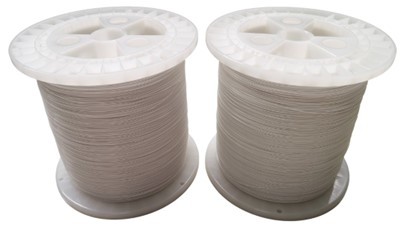
In the realm of high-performance cabling, material selection dictates failure or success. Silver Plated Nickel (SPN) PTFE Wire is engineered to bridge the gap between the high conductivity of silver and the mechanical robustness of nickel. This composite design offers a fail-safe solution for industries ranging from aerospace to precision medical instrumentation.
Below, we analyze the specific technical advantages that make this wire the superior choice for critical applications.
1. Superior Solderability & Reduced Thermal Stress
Key Benefit: Rapid Wetting & Component Protection
Pure nickel is notoriously difficult to solder due to rapid surface oxidation (passivation). This often requires aggressive acid fluxes that can corrode sensitive PCBs over time. Horle solves this by plating the core with high-purity silver. The silver layer ensures instant solder wetting without the need for aggressive fluxes. Crucially, this rapid wetting significantly reduces the "dwell time" (heating time) required during soldering. This minimizes the risk of thermal shock to sensitive electronic components, ensuring a reliable connection without damaging the sensor or chip.
2. Thermal Stability & Mechanical Integrity
Key Benefit: Performance at 260°C+
Unlike copper, which softens and suffers from "Red Plague" (corrosion) above 200°C, the primary advantage of Horle's Nickel 200/201 core is its exceptional Thermal Stability. While nickel is not a heat sink, it retains its mechanical rigidity and tensile strength in extreme heat where other metals would fail. The silver plating protects the nickel from oxidation, allowing the wire to operate continuously in 260°C environments (limited only by the PTFE). This makes it ideal for "hot zones" like automotive engine bays and industrial ovens, ensuring the wire does not become the weak link in the system.
3. Chemical Inertness (The PTFE Advantage)
Key Benefit: Total Immunity to Solvents
The extruded PTFE (Polytetrafluoroethylene) jacket is the ultimate shield. It is chemically inert, meaning it is virtually immune to hydraulic fluids, aviation fuels, acids, and alkalis. This feature is non-negotiable for medical and chemical industries. Whether exposed to sterilization autoclaves or corrosive factory environments, the insulation will not crack, swell, or degrade, preventing catastrophic short circuits caused by fluid ingress.
4. Dielectric Strength & Space Saving
Key Benefit: Thinner Walls, High Voltage Safety
PTFE offers one of the highest dielectric strengths of any polymer (approx. 60kV/mm). This allows Horle to manufacture wires with extremely thin insulation walls that still meet high voltage breakdown requirements.
The result: A lighter, smaller diameter wire that saves critical space in high-density connectors and miniaturized medical probes, without compromising electrical safety.
5. Customization & Identification
Key Benefit: Complex Harness Management
In complex wiring harnesses, identification is key. Horle provides SPN wires in a full spectrum of standard RETMA colors (Red, Black, White, Green, etc.) and offers custom striping options. This flexibility simplifies troubleshooting and assembly for our OEM clients.
FAQ
Q1: Why choose Silver Plated Nickel over Silver Plated Copper (SPC)?
A: The primary reason is temperature and corrosion. SPC suffers from "Red Plague" (corrosion) at temperatures above 200°C. Horle's Nickel core is immune to this, making it the only safe choice for applications exceeding 250°C.
Q2: Does the silver plating wear off over time?
A: No. Horle uses an electroplating process that creates a metallurgical bond between the nickel and silver. Unless the wire is mechanically abraded, the silver layer remains permanent, protecting the core from oxidation.
Q3: Is this wire suitable for high-frequency signal transmission?
A: Yes. Due to the "Skin Effect," high-frequency signals travel along the outer surface of the conductor. Since the surface is pure silver (the best conductor), this wire performs exceptionally well for RF and data transmission.
Q4: Can Horle customize the wire for specific voltage ratings?
A: Yes. While our standard PTFE wire is rated for 300V/600V, we can adjust the insulation wall thickness to meet specific UL or military voltage requirements for your project.
Q5: What is the minimum order quantity (MOQ) for custom colors?
A: We understand the needs of R&D and prototyping. Horle offers flexible MOQs for standard colors and competitive terms for custom color-matched runs. Please contact our sales team for a quote.