
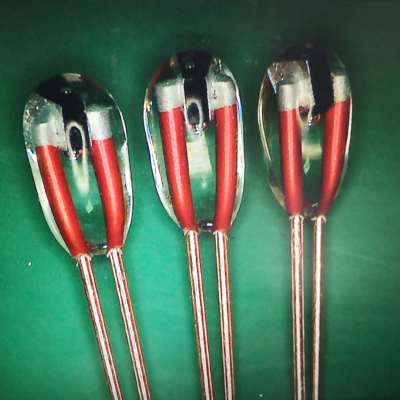
The terms “glass encapsulated thermistor” and “glass bead thermistor” are often used together, and sometimes confused. They are related, but they are not exactly the same thing.
This article explains the difference and helps you decide which one fits your application.
The Short Answer
A glass bead thermistor is one form of a glass encapsulated thermistor.
Glass encapsulation describes how the thermistor is sealed. Glass bead describes the shape and construction of the sensing element. In practice:
- A glass bead thermistor is small, fast, and suited to point measurement.
- A glass encapsulated thermistor is the broader category, often supplied as a more standardized axial-leaded component.
What Is a Glass Encapsulated Thermistor?
A glass encapsulated thermistor is an NTC thermistor sealed in glass to protect the sensing element from moisture, chemicals, and mechanical damage.
Common glass encapsulated forms include:
- Glass bead type.
- Chip-in-glass type.
- Axial leaded glass type.
The glass seal improves long-term stability and makes the thermistor suitable for demanding environments.
Explore our glass encapsulated NTC thermistors for available configurations.
What Is a Glass Bead Thermistor?
A glass bead thermistor uses a small NTC ceramic bead with two fine lead wires. The bead is then covered with a thin layer of glass.
Because the bead is small, it has low thermal mass and responds quickly to temperature changes. It is often used in:
- Medical temperature probes.
- Precision instruments.
- Fast point measurement.
- Small sensor assemblies.
For the sensing chip itself, see our NTC thermistor chips.
Glass Encapsulated vs Glass Bead: Key Differences
| Factor | Glass bead thermistor | Glass encapsulated thermistor |
|---|---|---|
| Structure | NTC bead with fine lead wires and a thin glass coating | Thermistor chip or bead sealed in a glass body |
| Size | Very small, often 0.5–2 mm | Usually larger, depends on package |
| Response time | Faster due to low thermal mass | Depends on size and construction |
| Lead wires | Fine, flexible lead wires | Often standardized axial leads |
| Durability | More fragile, sensitive to lead stress | More rugged, better mechanical protection |
| Moisture resistance | Good | Strong, with a full glass seal |
| Typical use | Fast point sensing, medical probes, precision instruments | Long-term stability, harsh environments, standard assemblies |
This comparison is a general guide. The final choice should be confirmed against the temperature range, accuracy, and mounting requirements.
When to Choose a Glass Bead Thermistor
Choose a glass bead thermistor when:
- Fast response time is important.
- Space is very limited.
- The sensor must measure a specific point.
- The assembly allows careful handling of fine lead wires.
When to Choose a Glass Encapsulated Thermistor
Choose a glass encapsulated thermistor when:
- Long-term stability is critical.
- The sensor will face moisture or harsh conditions.
- You need a standardized axial-leaded package.
- Mechanical protection matters more than minimal size.
For harsh-environment designs, see our article on glass encapsulated thermistors for harsh environments.
How to Decide in Three Steps
Step 1: Check Response Time and Space
If you need fast response in a small space, start with a glass bead type. If the design has room for a standard package, glass encapsulation gives more mounting options.
Step 2: Check the Environment
For moisture, chemicals, or vibration, choose a fully sealed glass encapsulated thermistor. For a clean, controlled environment, a glass bead may be enough.
Step 3: Confirm Electrical Parameters
Both types still need the same basic parameters:
- R25 value.
- B value, such as B25/85.
- Resistance tolerance or temperature accuracy.
- Lead wire length and insulation.
- Operating temperature range.
If you are comparing glass and epoxy designs, see our article on glass encapsulated thermistors vs epoxy coated thermistors.
Common Misunderstandings
Are glass bead and glass encapsulated the same thing?
A glass bead thermistor is a type of glass encapsulated thermistor, but glass encapsulation also includes other forms such as chip-in-glass and axial leaded types.
Is a glass bead always faster?
Usually, because its thermal mass is lower. But a very thin-wall glass encapsulated probe can also respond quickly. Response time depends on the complete assembly, not only the bead.
Are glass bead thermistors always fragile?
They are more sensitive to lead stress and mechanical shock. Proper mounting and strain relief reduce the risk.
Can I replace one with the other?
Not without checking the circuit and mechanical fit. The R25, B value, package size, and lead configuration must match.
For mounting guidance, read how to mount glass NTC thermistors without breaking them.
Frequently Asked Questions
What is the main difference between the two?
Glass bead describes a small bead-shaped sensing element, while glass encapsulation describes the sealing method. A glass bead thermistor is one type of glass encapsulated thermistor.
Which one is better for a medical temperature probe?
Medical probes often use glass bead or small glass encapsulated thermistors because they respond quickly and can be made very small. The final choice depends on accuracy, lead wire, and sterilization requirements.
Which one is more durable?
A fully glass encapsulated thermistor with a standard package is usually more rugged than a bare fine-wire glass bead.
Do they use the same R25 and B values?
They can use the same electrical parameters. The choice between bead and encapsulated package is mostly about size, response, and mechanical design.