
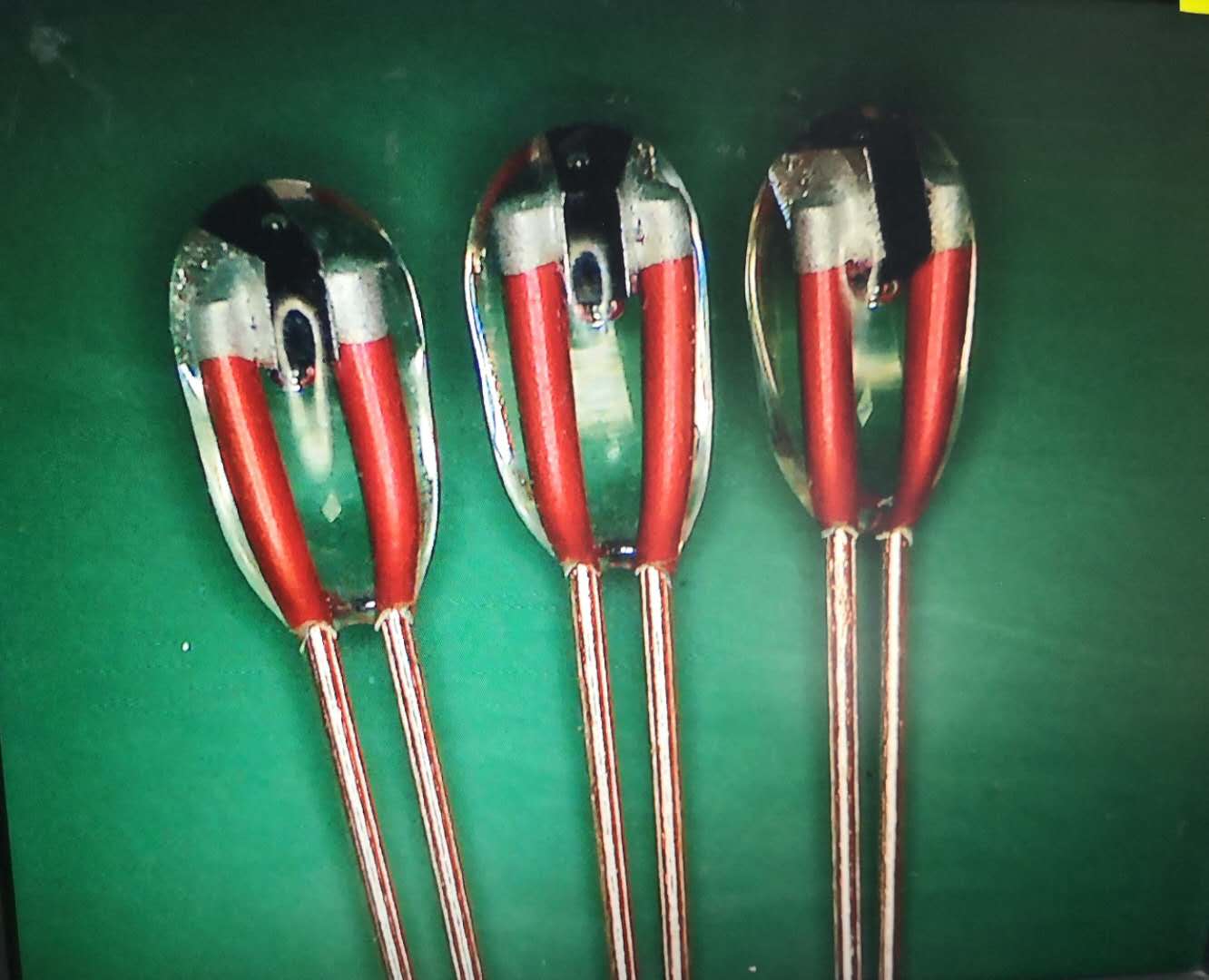
3 Core Rules for Mounting Glass NTC Thermistors
- The 2mm Bending Rule: Never bend the lead wires closer than 2mm to the glass body. Always use a clamping tool between the glass and the bend to isolate mechanical stress and protect the hermetic seal.
- Prevent Thermal Shock: Limit manual soldering temperatures to 300°C for a maximum of 3-5 seconds. Always attach a heat sink (like a copper alligator clip) to the leads to draw destructive heat away from the glass envelope.
- Manage Thermal Expansion: Avoid encapsulating the sensor in rigid potting compounds like hard epoxy. Design a small "U-bend" in the leads and use flexible silicone to absorb mechanical stress during extreme temperature fluctuations.
Why Are Glass NTC Thermistors So Fragile Yet Indispensable for High-Temperature Applications?
Glass encapsulated NTC (Negative Temperature Coefficient) thermistors provide unmatched durability and stability in extreme chemical and thermal environments. Unlike their epoxy-coated counterparts, these specialized sensors offer a rapid thermal response and the ability to operate reliably at extremely high temperatures, often exceeding 250°C or even 300°C. The hermetic glass seal acts as an impenetrable barrier against moisture, corrosive gases, and harsh industrial chemicals. This exceptional resistance makes them the absolute go-to choice for demanding automotive, industrial, and aerospace applications where standard temperature sensors would quickly degrade and fail.
However, this robust chemical and thermal protection comes with the critical trade-off of extreme mechanical fragility. The glass body is inherently brittle and highly sensitive to both mechanical stress and sudden thermal shock. When engineers and technicians integrate these sensors into printed circuit boards (PCBs) or complex probe assemblies, the slightest mishandling can easily induce micro-cracks in the glass envelope. These microscopic fractures might not be immediately visible to the naked eye, but they fundamentally compromise the hermetic seal. Over time, moisture ingress will cause the thermistor's resistance values to drift, ultimately leading to the catastrophic failure of the entire temperature control system.
How Should You Handle and Store Glass NTC Thermistors Before Installation?
Proper handling and storage before installation are foundational steps required to prevent invisible structural damage to a glass NTC thermistor. These delicate components should always be kept securely in their original, protective packaging until the exact moment of assembly. This strict storage protocol prevents accidental drops, crushing weights, or collisions with other hard metallic components on a crowded workbench. Because the glass envelope is particularly susceptible to impact damage, simply tossing them into a loose component bin is a guaranteed way to induce invisible structural weaknesses that will inevitably cause failures later in the field.
Strict protocols must also be followed when transferring and manipulating these components on the active assembly line. Operators must be rigorously trained to handle the sensors exclusively by their lead wires, strictly avoiding any pinching or squeezing of the glass body itself. Using hard metal tweezers directly on the glass is a common but highly dangerous practice, as the sharp metal edges can easily scratch, chip, or shatter the fragile surface. If tweezers must be used for precise PCB placement, they should be made of plastic or feature soft, non-abrasive tips. Additionally, storage environments must maintain stable humidity levels; while the glass is impervious to moisture, oxidized lead wires will complicate the soldering process and force operators to apply excessive heat later on.
What Are the Golden Rules for Bending and Forming Glass NTC Thermistor Leads?
The most critical rule during lead forming is maintaining a strict 2mm safety distance between the bending point and the glass body. When you bend the lead wire of a glass NTC thermistor, the mechanical force travels directly along the metallic wire toward the glass seal. If this mechanical stress reaches the delicate glass-to-metal interface, it will shatter the hermetic seal instantly. Establishing this 2mm buffer zone ensures that the rigid glass structure is completely isolated from the leverage forces applied during the bending operation, preserving the integrity of the sensor.
To execute this safe bend effectively, operators must completely isolate the mechanical stress from the glass envelope using the proper tools. This isolation is achieved by firmly clamping the lead wire between the glass body and the intended bending point using a dedicated tool, such as flat-nose pliers. The clamping tool acts as a solid mechanical barrier, absorbing all the bending force so that absolutely zero stress transfers to the glass. Operators must never bend the leads by holding the glass body with their fingers and pushing the wire, as this makes the fragile glass the fulcrum of the bend. For high-volume production, utilizing automated lead-forming machines with precisely calibrated clamping mechanisms is highly recommended to ensure consistent adherence to the 2mm safety margin for every single glass NTC thermistor.

How Can You Solder Glass NTC Thermistors Without Causing Thermal Shock or Seal Failure?
Soldering introduces an intense, localized heat source that can easily destroy a glass NTC thermistor through rapid thermal shock. Glass is a notoriously poor conductor of heat, meaning that when one part of the glass envelope heats up rapidly while the rest remains cool, massive internal thermal stresses build up aggressively. This uneven heating phenomenon can cause the glass to crack spontaneously during or immediately after the soldering process. Therefore, strictly controlling the thermal profile and understanding the heat transfer dynamics is a non-negotiable aspect of successful sensor integration.
Minimizing the duration and intensity of heat exposure is paramount across all soldering techniques to protect the glass NTC thermistor. For manual hand soldering, the soldering iron tip temperature should generally not exceed 300°C, and the contact time must be strictly limited to a maximum of three to five seconds. If the design requires the sensor to be mounted flush against the PCB with very short leads, technicians must employ a heat sink, such as attaching a copper alligator clip to the lead wire between the solder joint and the glass body. This simple intervention draws the excess thermal energy away before it can reach the vulnerable hermetic seal. Furthermore, pre-heating the PCB and the components can significantly reduce the temperature gradient, thereby mitigating the overall risk of thermal shock.
How Do You Mechanically Mount and Pot Glass NTC Thermistors to Handle Thermal Expansion?
Mechanical securing methods must account for the coefficient of thermal expansion (CTE) mismatch to avoid crushing the glass NTC thermistor. As the device heats up and cools down during normal operation, the PCB, the potting resin, and the glass thermistor will all expand and contract at vastly different rates. If the sensor is rigidly encapsulated in a hard epoxy, the shrinking resin during the cooling phase will exert immense crushing forces on the glass. This mechanical compression often leads to delayed failures in the field, long after the product has passed initial factory testing.
Intelligent stress relief mechanisms are required to combat these thermal and mechanical forces during the final mounting phase. When designing the PCB layout, engineers should allow for a slight "U-bend" or expansion loop in the lead wires. This small amount of slack acts as a mechanical shock absorber, compensating for any dimensional changes caused by thermal cycling or physical vibration. If potting or encapsulation is absolutely necessary for environmental protection, you must select a flexible, low-stress compound, such as a soft silicone elastomer (e.g., RTV silicone). Similarly, if using heat-shrink tubing to insulate the leads, ensure that the tubing does not overlap onto the glass body, as the shrinking plastic can squeeze the glass with surprising and destructive force.
What Are the Most Common Glass NTC Thermistor Mounting Failures and How to Troubleshoot Them?
A sudden, inexplicable shift in the resistance value is the primary symptom of a compromised hermetic seal in a glass NTC thermistor. This failure mode is almost always caused by microscopic cracks induced by improper lead bending or thermal shock during soldering. Once the glass envelope is breached, ambient moisture penetrates the sensor and interacts directly with the semiconductor ceramic chip inside. This moisture ingress drastically alters the electrical properties of the chip, causing erratic temperature readings and rendering the sensor completely useless for precise control applications.
Intermittent open circuits represent another major failure mode driven by severe metal fatigue during the installation process. This typically happens when the lead wire has been bent back and forth too many times by an operator trying to align the component, which severely weakens the metal structure. While the wire may look perfectly intact from the outside, the internal conductive path is broken, leading to a sensor that only works at certain temperatures or when physically pressed. To troubleshoot these issues effectively, engineers should implement a strict visual inspection protocol using high-powered magnification after the soldering stages, audit the lead-forming tools, and retrain operators on the mandatory use of heat sinks.
Frequently Asked Questions About Glass NTC Thermistor Integration
Here is a quick reference guide addressing the most common queries engineers have when working with these delicate components.
| Common Question | Expert Answer & Recommendation |
| Can I use ultrasonic cleaning on PCBs with a glass NTC thermistor? | It is generally discouraged. High-frequency ultrasonic vibrations can induce resonance in the fragile glass envelope or the internal wire bonds, leading to micro-fractures. Use gentle, localized solvent brushing instead. |
| How short can I cut the lead wires for a compact installation? | While you can trim the leads, you must never cut them closer than 2mm to the glass body. Shorter leads drastically increase the risk of thermal shock, necessitating strict heat-sinking protocols for every glass NTC thermistor. |
| Is it safe to glue the glass body directly to a metal heat sink? | Direct rigid bonding is risky due to thermal expansion differences. Always use a highly flexible, thermally conductive silicone adhesive to buffer the mechanical stress between the glass and the metal surface. |
Conclusion
Mastering the installation of a glass NTC thermistor requires a fundamental shift in manufacturing mindset: you must treat them with the mechanical delicacy of fine glassware while relying on their industrial-grade thermal performance. By strictly enforcing the 2mm bending rule, utilizing heat sinks during soldering, and designing for thermal expansion, you can completely eliminate handling-induced failures and unlock the full, reliable lifespan of these exceptional sensors.