
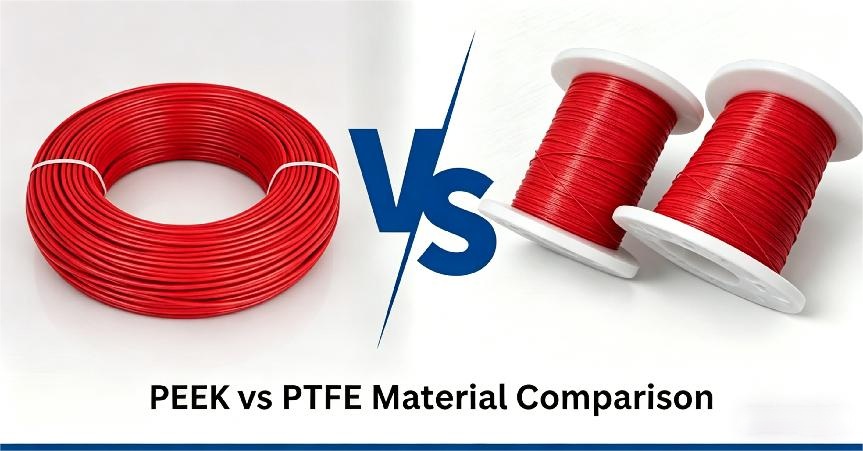
In high-precision environments—from electrochemical cells to aerospace sensors—selecting the wrong polymer insulation isn't just a minor error; it’s a looming system failure. While PTFE (Polytetrafluoroethylene) is often the "default" for its chemical inertness, PEEK (Polyether Ether Ketone) has emerged as the gold standard for structural integrity.
But when does the high cost of PEEK justify the investment, and where does PTFE remain untouchable? Let’s unpack the engineering reality.
Is PEEK or PTFE Better for Chemical Resistance?
The most common point of failure in wire insulation is chemical degradation. While both polymers are high-performance, their "Achilles' heels" are vastly different.
The "Inert" King: PTFE
PTFE is virtually universal in its resistance. It remains stable in the presence of almost all acids, bases, and solvents. Its only true enemies are molten alkali metals and certain rare fluorinated oils at extreme temperatures.
The PEEK "Red List"
PEEK is robust but has specific vulnerabilities that can lead to sudden embrittlement or dissolution. You must avoid PEEK if your environment contains:
- Strong Oxidizing Acids: Concentrated Sulfuric Acid (>75%), Nitric Acid (>50%), or Aqua Regia.
- Halogens: Bromine, Chlorine, or Hydrofluoric Acid.
- Specific Organics: Phenols and certain chlorinated solvents like Dichloromethane (DCM) can cause swelling or deformation.
Engineering Rule: If your fluid path involves unknown or highly aggressive oxidizing agents, PTFE is your insurance policy.
Why Does PEEK Outperform PTFE in High-Pressure Mechanical Stability?
Engineers often face the "Cold Flow" nightmare with PTFE. Under constant load, PTFE behaves like a high-viscosity liquid, slowly deforming over time.
The Strength Gap
| Property | PEEK (Virgin) | PTFE (Virgin) | Winner |
| Tensile Strength | 90 - 100 MPa | 20 - 35 MPa | PEEK |
| Shore Hardness | 85 D | 55 D | PEEK |
| Flexural Modulus | 3,900 MPa | 500 MPa | PEEK |
Dealing with "Creep"
In applications like HPLC (High-Performance Liquid Chromatography) or downhole oil sensors, PEEK’s rigidity is vital. PTFE wires under mechanical clamps will eventually "creep," leading to loose connections or insulation thinning. PEEK maintains its dimensions even under intense cycling, making it the superior choice for structural wire housing.
How Does Temperature Affect the Dimensional Stability of PEEK vs. PTFE?
Both materials handle heat well, but their expansion behavior is where the danger lies for precision instruments.
The 19°C - 25°C "Phase Transition"
PTFE undergoes a specific crystalline phase change near room temperature (approx. 19°C), causing a non-linear volume increase. Above 25°C, its coefficient of thermal expansion (CTE) becomes erratic. In a tightly packed sensor, this expansion can cause PTFE insulation to "extrude" out of fittings or create gaps where electrolytes can seep in.
PEEK’s Linear Reliability
PEEK offers a much lower and more linear CTE. Up to 150°C, its movements are predictable. If your project requires a "set it and forget it" fit in a variable temperature environment, PEEK’s thermal stability prevents costly leaks and mechanical interference.
Maintenance and Processing: What Are the Hidden Costs?
The "sticker price" of PEEK is significantly higher than PTFE, but the Total Cost of Ownership (TCO) tells a different story.
- The Polishing Paradox: PEEK is so hard that standard alumina polishing powders won't wear it down. If you are using PEEK as an electrode body, you need machine polishing to keep the surface flush.
- Durability vs. Replacement: PTFE wires are prone to surface scratches and "nicks" during assembly. PEEK’s abrasion resistance means fewer replacements in high-friction environments, often offsetting its initial 3x–5x price premium.
The Decision Matrix: PEEK vs. PTFE Quick-Reference
| If your priority is... | Choose... | Why? |
| Universal Chemical Inertness | PTFE | Resists almost everything except alkali metals. |
| High Pressure (>1000 psi) | PEEK | High tensile strength; zero "cold flow." |
| Precision Dimensional Fit | PEEK | Linear thermal expansion; won't deform. |
| Low Friction / Non-Stick | PTFE | Lowest coefficient of friction of any solid. |
| Cost-Sensitive / Mild Conditions | PTFE | Economical and widely available. |
Conclusion: Making the Risk-Averse Choice
In 2026, engineering is about predictability.
- Choose PTFE for its chemical "blanket" protection and low-friction properties in non-load-bearing roles.
- Choose PEEK when your wires must act as structural components, endure high pressures, or maintain sub-millimeter precision under thermal cycling.
FAQ
Q: Can PEEK replace PTFE in all medical applications?
A: Not necessarily. While PEEK is biocompatible and stronger, PTFE is preferred for catheters and guide wires due to its superior lubricity (low friction), which PEEK cannot match.
Q: Is PEEK wire insulation fire-resistant?
A: Yes, PEEK is inherently flame-retardant with a very high V-0 flammability rating and produces minimal smoke or toxic gas when exposed to flame, often outperforming PTFE in aerospace safety standards.
Q: Why is my PTFE-insulated wire leaking at high temperatures?
A: This is likely due to PTFE’s non-linear thermal expansion. As it heats up, it expands more than the metal housing, potentially deforming the seal. Once it cools, it may not return to its original shape, creating a leak path.
Q: Does UV exposure affect PEEK or PTFE?
A: PTFE is essentially immune to UV degradation. PEEK has good resistance but can show slight surface discoloration over very long-term exposure to intense UV radiation.
Q: Which material is better for high-frequency signal transmission?
A: PTFE generally has a lower dielectric constant (≈2.1≈2.1) compared to PEEK (≈3.2≈3.2), meaning PTFE typically offers lower signal loss (attenuation) in high-frequency RF applications.